When it comes to resistance training, there are a lot of things to think about—like how much weight you lift, how many sets and reps you do, and how long you rest between sets.
But one key factor that often gets overlooked is your technique—how you perform each rep.
Lately, there’s been a lot of debate about the “perfect” way to do exercises. You’ve probably seen people arguing online, saying things like:
"Hey, you're doing the lat pulldown all wrong! You need to line up your back muscles perfectly and move the bar in a super-specific way."
I get it—you’re just trying to build muscle, lose fat, and get healthier, not launch a spaceship to Mars.
So, let’s keep it simple.
A recent study by Korakakis and colleagues looked into the best lifting techniques for muscle growth. They defined good technique as:
✅ Controlling your movements
✅ Targeting the right muscles
✅ Avoiding injury
✅ Using a full range of motion (ROM)
✅ Maintaining proper body alignment
The key takeaway? There’s no single “perfect” way to lift. The most important thing is to train your muscles through a full range of motion, especially focusing on stretching them at longer lengths.
Before we start, we should probably get some definitions in place so we’re all on the same page.
Repetition tempo
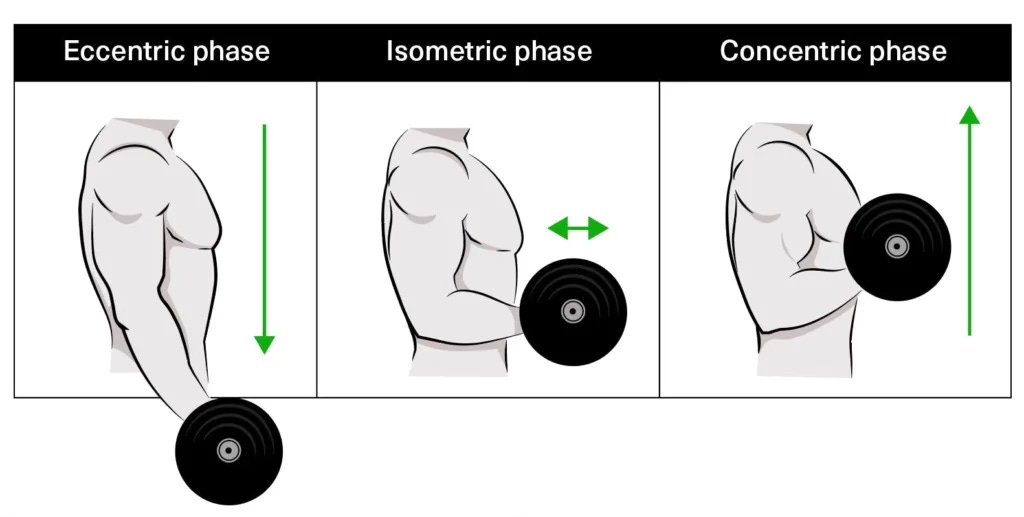
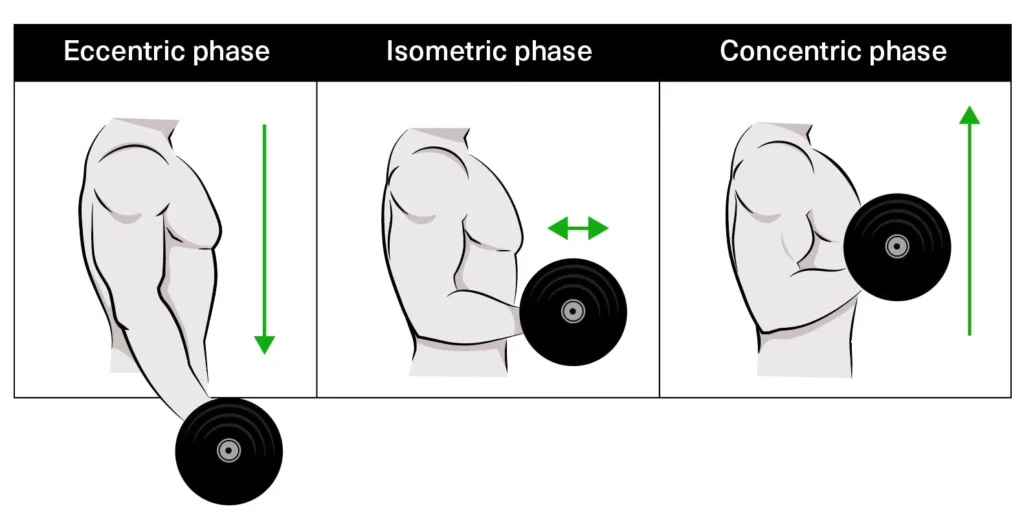
Repetition Tempo refers to how fast or slow you complete one full rep of an exercise. Each rep has three phases:
Concentric phase – when the muscle shortens (e.g., curling a dumbbell up in a bicep curl).
Isometric phase – when you pause and hold at any point (e.g., stopping halfway through the curl).
Eccentric phase – when the muscle lengthens (e.g., lowering the dumbbell back down).
The speed at which you move through these phases can impact muscle growth, strength, and control.
Range of Motion
Range of Motion (ROM) refers to how far a joint can move during an exercise.
Using the bicep curl as an example:
A full range of motion means starting with your arm straight down by your side and curling the dumbbell all the way up to your shoulder.
In this case, the elbow joint is doing the movement, and the bicep is working through its full range.
Training with a full ROM helps maximize muscle activation and flexibility while reducing injury risk.
How Does Repetition Tempo Affect Muscle Growth?
There’s a lot of research on rep tempo, but in general, the ideal range for muscle growth is a total rep duration of 2 to 8 seconds.
This includes all three phases:
Concentric (muscle shortening, like pushing up in a squat)
Eccentric (muscle lengthening, like lowering into a squat)
Isometric (pauses, like holding at the bottom of a squat)
Examples of Rep Tempo in Action:
3-Second Tempo – 1 second to lift, 2 seconds to lower.
5-Second Tempo (with a pause) – 1 second to lift, 2-second pause at the bottom, 2 seconds to lower.
What’s the Best Approach?
When I train clients, I keep it simple:
✅ 2-3 seconds lowering (eccentric)
✅ 0-1 second pause (depends on the exercise)
✅ 1 second lifting (concentric)
While research is still evolving, some studies suggest that slowing down the eccentric (lowering) phase might lead to better muscle growth. That’s why focusing on controlled movements—especially during the lowering phase—can be a smart strategy for maximizing gains!
How Does Range of Motion (ROM) Affect Muscle Growth?
Most research suggests that training with a full range of motion (ROM) is more effective for muscle growth than using a partial range of motion.
However, newer studies indicate that training in a partial range of motion at long muscle lengths might be just as effective—or even better—than training at short muscle lengths.
What Does ‘Partial ROM at Long Muscle Lengths’ Mean?
A long muscle length is when the muscle is fully stretched. For example, if you extend your arm behind your back with a straight elbow, your biceps are fully lengthened.
To train in a partial ROM at long muscle lengths, you would:
✅ Perform only the bottom half of a bicep curl (lifting the dumbbell from your side to about a 90-degree elbow bend, rather than all the way to your shoulder).
How to Apply This in Training
Prioritize full ROM whenever possible—based on what feels comfortable and natural for your body (not everyone can do a deep squat, but most can reach parallel).
Try adding partial reps at long muscle lengths to challenge your muscles differently. For example:
1️⃣ Do your first two sets of full ROM bicep curls.
2️⃣ On the third set, go to failure with full ROM and then add extra reps using only the bottom half of the movement.
This approach can help increase muscle activation and stimulate growth in a new way! 💪
My Recommendation for Muscle Growth
For the best muscle growth, I generally advise my students to:
✅ Perform exercises through a full range of motion whenever possible.
✅ Focus on safe execution to prevent injury.
✅ Ensure you can feel the target muscle working—at least to some extent.
That said, just because you don’t “feel” a muscle working doesn’t mean it’s not being trained. But if you’re doing bicep curls and only feeling it in your glutes… well, something’s definitely off! 😅
Key Takeaways for Muscle Growth
✅ Rep Tempo – Aim for 2-8 seconds per rep. A simple guide: 2-3s eccentric, 0-1s pause, 1s concentric. Longer eccentrics/pauses can make exercises harder.
✅ Full ROM is Best – Training through a full range of motion generally leads to better muscle growth.
✅ Partial ROM at Long Muscle Lengths Works Too – Training in a stretched position can be just as effective. Use it occasionally to mix things up.
✅ Form is Individual – No universal “perfect” technique. Train safely and feel the target muscle.
✅ Some Cheating is Okay – A little form breakdown is fine if it helps progression.
✅ Stay Consistent – Try to standardize reps so you can track progress effectively.
References:
Optimizing Resistance Training Technique to Maximize Muscle Hypertrophy: A Narrative Review
Partial Vs Full Range of Motion Resistance Training: A Systematic Review and Meta-Analysis
Want a personalized routine?
Book a free consultation with Coach Keshav and get a custom science-backed workout plan tailored to your goals.